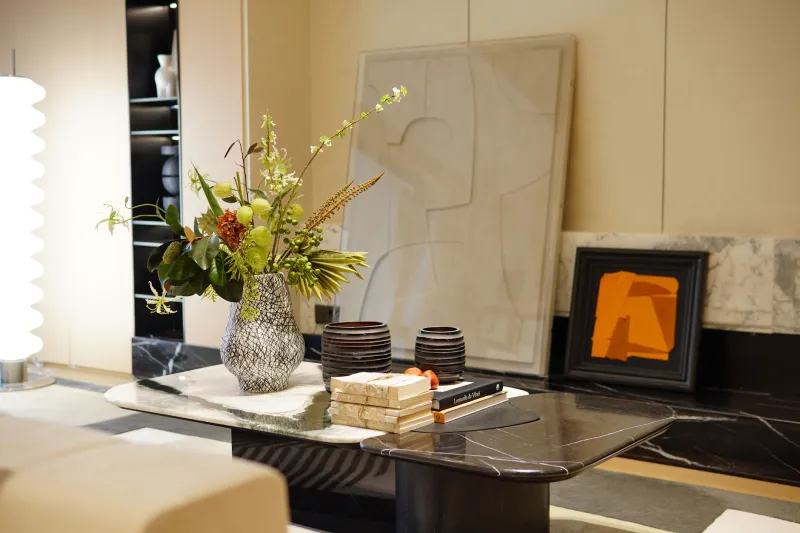
Let's paint a picture. It's Saturday morning. You wake up, shuffle into your living room, and instead of feeling the warm, chaotic comfort of a space that belongs to you, you feel a vague, low-grade anxiety that the throw blanket is draped at the wrong angle. You fix it. You step back. You assess. You wonder if the arch floor lamp is too close to the rattan side table. You consider, genuinely consider, whether the travertine candle holders are giving what they're supposed to give.
Your home has become your least favorite coworker — always demanding attention, impossible to please, and somehow making you feel bad about yourself before you've even had coffee.
This is the aesthetic prison. And the door? It was never locked. You just forgot that leaving was an option.
How We Got Here (Spoiler: It Was Pinterest's Fault First, Then TikTok Made It Worse)
The home aesthetics spiral didn't begin with TikTok, but TikTok absolutely turbocharged it into something unhinged. Before the algorithm got involved, you might have ripped a page out of a magazine, taped it to your fridge, and called that your interior design inspiration. Simple. Sustainable. Delusional in a harmless way.
Then Pinterest arrived and gave us mood boards. Then Instagram made us want our actual homes to look like the mood boards. Then TikTok showed us forty-seven different ways to style a bookshelf in the time it takes to microwave soup, and suddenly the bar was not just high — it was floating somewhere in the stratosphere, surrounded by neutral tones and Edison bulbs.
The "that girl" aesthetic industrialized the whole thing. You know the look: creamy whites, organic shapes, a tiny succulent that costs thirty dollars because it came from the right boutique, and an overall vibe that says I wake up naturally at 6 a.m. and my life is a soft-focus documentary about wellness. It's aspirational. It's also completely exhausting to maintain when you are, in fact, a regular person who sometimes eats cereal directly from the box while standing over the sink.
The TikTok Home Haul Trap Is Specifically Designed to Break You
Here's the economic engine running underneath all of this: TikTok Shop, Amazon storefronts, and the relentless churn of viral home products that look incredible in a fifteen-second video and arrive at your door looking like a slightly sadder version of the thing you ordered.
The algorithm is ruthless. It watches you pause on a video of someone's "cozy reading nook" for two seconds too long, and then it decides you need to see every possible variation of a cozy reading nook for the next seventy-two hours. By the end of the week, you've purchased a curved bookshelf, a mushroom lamp, and a sheepskin rug that sheds like a golden retriever in July.
None of it quite coheres. None of it quite looks like the video. But you keep buying because the next thing might be the thing that finally makes the room feel done. Spoiler: rooms never feel done. That's not a design problem. That's a psychological trap disguised as interior decorating.
The home haul content creator knows this. Their apartment is never finished either — it just looks finished for the duration of the video, which is filmed in the one corner of their place that isn't a disaster. The rest of the apartment is a pile of returned Amazon boxes and aesthetic casualties. You are not seeing the whole picture. You are seeing the forty-five-degree angle that makes everything look like a Pottery Barn catalog.
Performing Domesticity for an Audience That Isn't Watching
Here's the part nobody wants to say out loud: most of us are staging our homes for an audience that doesn't exist. Or at least, an audience that visits far less frequently than the anxiety about their hypothetical judgment would suggest.
You are rearranging your coffee table books — which you have not read and did not buy to read — for guests who come over twice a year. You are keeping your kitchen counters aggressively clear because somewhere in your brain lives an imaginary interior design critic who is always watching and always disappointed. You are living inside a performance of a life rather than inside an actual life.
This is the real psychological hook of aesthetic culture: it outsources your sense of home from how this space makes me feel to how this space makes me look. And those are wildly different metrics. A space that makes you feel good might involve a beloved, structurally questionable secondhand couch and a lamp you've had since college. A space that makes you look good involves buying a new lamp every eight months because the algorithm decided the previous lamp's aesthetic era was over.
One of those costs nothing. One of those costs a significant portion of your disposable income and a non-trivial amount of your sanity.
The Cottagecore-to-Coastal-Grandmother Pipeline Is Moving Too Fast
Aesthetics have always cycled, but the speed at which TikTok burns through them has become genuinely absurd. Remember when we were all doing cottagecore? Mushrooms everywhere, prairie dresses, the vibe of a Victorian child who lives in a forest. That was, by internet time, approximately forty-five minutes ago.
Then it was dark academia. Then coastal grandmother. Then quiet luxury. Then "looksmaxxing" crossed over into home design somehow and now everyone is talking about whether their apartment has good bone structure. The trend cycle is moving so fast that by the time you've purchased the items required for one aesthetic, you're already three aesthetics behind and the stuff you bought is considered passé by people who were also just buying it six weeks ago.
The brands love this. The content creators love this. The algorithm, which is not capable of love but is definitely capable of optimization, loves this. The only person not benefiting from the speed of the aesthetic churn is you, standing in your living room surrounded by three different eras of throw pillows, wondering where your money went.
A Modest Proposal: Let Your Home Be Ugly (On Purpose)
The most radical act in 2025 might just be decorating your home in a way that prioritizes your actual comfort over its visual coherence. Keep the couch that's too big for the room because it's the most comfortable couch you've ever experienced. Put the art on the wall that you love even though it clashes with literally everything. Own the lamp that makes no design sense but makes you happy every time you turn it on.
Let your home be a little weird. Let it be a little personal. Let it accumulate the random detritus of a life actually being lived — the travel souvenir that doesn't fit any aesthetic, the stack of books that have no business being displayed spine-out, the throw blanket that's fraying at the edges because you've used it approximately one thousand times.
A home that looks lived-in is not a home that has failed. It's a home that's succeeding at its actual job, which is to be the place where you exist, unperformed and unbothered.
The mood board can wait. The algorithm will survive without your participation. And your couch — the comfortable, aesthetically chaotic one you've been thinking about replacing — deserves better than to be swapped out for something that photographs well and feels like a decorative punishment.
Unlock the aesthetic prison. The exit was always right there. It was just blocked by a bouclé accent chair you bought in 2023 and kind of regret.