Glow-Up or Con Job? The Makeup Tutorial Industrial Complex Has Been Lying to Your Face
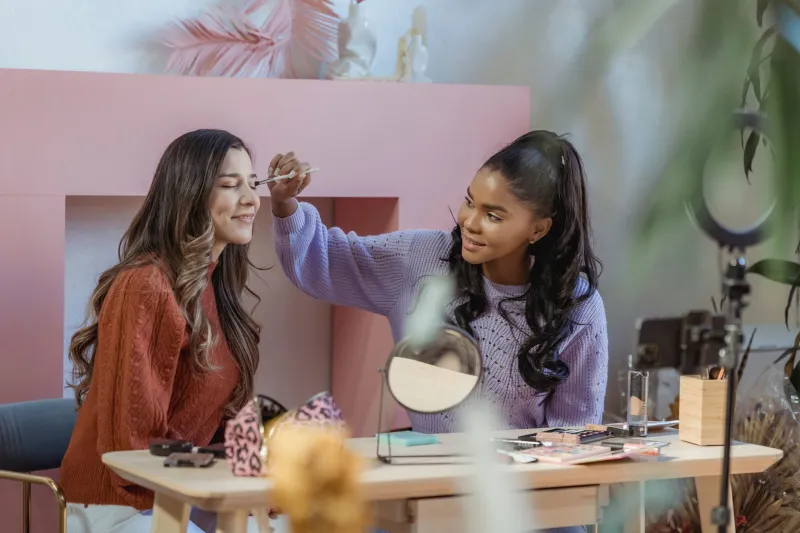
Let's set the scene. It's 11 p.m. You're lying in bed, skin bare, pores existentially visible, and you've just stumbled onto a makeup tutorial where someone transforms from 'tired human' to 'Renaissance painting subject' in approximately four minutes. You watch it again. You screenshot the products. You go to bed feeling like a before photo.
Congratulations. You've been fully processed by the Makeup Tutorial Industrial Complex.
This isn't about hating beauty content or canceling contouring. It's about the quietly elaborate machinery behind what gets sold to us as "easy," "natural," and — the most dangerous word in the beauty content dictionary — "achievable."
Spoiler: most of it isn't. And the people making it know that better than anyone.
The Lighting Situation Is Basically a Crime Scene
Before a single product is opened, the stage is already set — literally. Professional ring lights, softbox setups, and strategically angled natural window light don't just illuminate a face. They sculpt it. They fill in shadows. They make pores disappear like they're in witness protection. They make skin glow in ways that no amount of highlighter can actually replicate in the fluorescent horror of a CVS bathroom.
The "before" in most tutorials is already lit better than the average person's best day. And the "after" is lit even more aggressively, often with a warm filter baked into the camera settings before a single second of footage is exported.
Makeup artists who work in actual film and TV will tell you that lighting is 60% of the job. Beauty influencers have absorbed this lesson and applied it with ruthless efficiency. They just forgot to mention it in the caption.
Angles Are Doing the Heavy Lifting Nobody Talks About
Here's a fun experiment: film your face straight-on at eye level, then tilt the camera down slightly and film again. Different person, basically. Camera angle manipulation is so fundamental to beauty content that it's practically a genre convention at this point — except nobody narrates it like one.
The "before" shot is often taken from a slightly unflattering angle. Chin a little lower, lighting a touch harsher, maybe the camera is an inch closer than comfortable. The "after" shot? Camera pulled back, angle elevated, face turned at the exact 17-degree tilt that every influencer has privately workshopped for three years.
This isn't accidental. This is choreography. And we keep watching it like it's a documentary.
Filters: The Ingredient That's Never Listed
In an era where every skincare product is legally required to list its full ingredient deck, it's genuinely wild that video filters carry zero disclosure requirements. Smoothing filters, skin-evening tools built into apps like CapCut, TikTok's native beauty modes that activate by default — these are invisible collaborators in almost every tutorial you've ever watched.
Some platforms have started nudging creators toward disclosing filter use, but enforcement is basically nonexistent. A creator can slap "no filter" in the caption while running footage through an editor that softens every texture and bumps the saturation by 30%. Technically accurate. Spiritually dishonest.
The filter layer is particularly insidious because it's the one audiences are least equipped to spot. Weird lighting? You might notice. Suspicious angle? Maybe. But a skin-smoothing filter applied at 40% opacity in post? That's just vibes, apparently.
Why We Keep Watching (And Buying)
Here's the uncomfortable part: we know, on some level, that this is happening. The comments sections of these videos are full of people saying "I could never" and "this would look nothing like this on me" — and then buying the products anyway.
This is not stupidity. This is how aspirational content is engineered to work.
Makeup tutorials operate on the same psychological loop as lottery tickets. The rational part of your brain understands the odds. The emotional part sees someone win and thinks: but what if it's me this time? The tutorial isn't selling you a product. It's selling you the possibility of transformation. The hope that with the right tools and the right technique, you could look like someone whose entire job is looking like that.
Beauty brands have understood this for decades — the classic industry line is that you're not buying lipstick, you're buying confidence. Influencer culture just turbocharged the delivery method and made it feel personal, intimate, and weirdly like advice from a friend who happens to have a ring light and a six-figure brand deal.
The 'Realistic' Makeup Content Pipeline Is Also a Grift, Just a Different One
In response to the growing backlash against unattainable tutorials, a whole counter-genre has emerged: "realistic" makeup content. No filter, bad lighting, acne visible, honest about what the product actually does. These creators position themselves as the antidote to the industrial complex.
And look — some of them genuinely are. But a significant chunk of "realistic" content is just a different flavor of performance. The strategic messiness. The carefully selected "bad" lighting that still somehow looks charming. The self-deprecating caption that generates more parasocial trust — and therefore more affiliate link clicks — than any polished tutorial ever could.
Authenticity, when it becomes a content strategy, stops being authentic. It becomes a brand. And once it's a brand, it's selling you something, even if what it's selling is the feeling of being seen.
This is not a criticism of every creator who makes honest beauty content. Some of them are legitimately just people with cameras. But the ones with management teams and brand partnerships and merch drops? They've run the numbers on "relatable," and the numbers are good.
What You're Actually Owed (And What to Do With That)
None of this means you have to stop watching tutorials or feel embarrassed about loving beauty content. It's fun. It's creative. Some of it is genuinely impressive artistry. But consuming it without the decoder ring means you're constantly measuring your real face against someone's most optimized, most engineered, most commercially motivated presentation — and losing a competition you were never actually entered in.
The practical takeaways are pretty simple: look for tutorials filmed in natural, uncontrolled lighting. Watch creators who show their setup. Notice when the "before" and "after" are shot at different distances or angles. Treat any product that supposedly transforms your skin in a 60-second Reel with the same skepticism you'd give a weight-loss ad from 2003.
And maybe, just maybe, appreciate that your face — unlit, unfiltered, un-ring-lighted — is doing its absolute best in conditions that no influencer would ever agree to film in.
That's not a consolation prize. That's the actual win.